In the era of personalized medicine, "dynamic treatment plans" are crucial for the treatment of many chronic diseases such as cancer and diabetes. Doctors can adjust treatment plans in stages according to changes in the patients condition, thereby improving the patients treatment success rate.
This sounds like a win-win situation, but its not. Information asymmetry is particularly pronounced in the healthcare market. During the dynamic treatment process, only healthcare providers have access to information such as "How is the patients condition changing?" and "Does the treatment really need to be adjusted?" Insurance companies responsible for payouts often struggle to obtain this information in a timely manner.
Therefore, some medical service institutions may take advantage of this information asymmetry to "exploit loopholes," such as by ordering more tests, prescribing more medications, and prolonging hospital stays, in order to apply for more compensation from insurance companies.

|
Image source: ©千库网 |
This presents a challenge to the design of medical insurance payment policies. As the payer, how can insurance companies scientifically design the optimal payment mechanism for these dynamic treatment plans to ensure that patients receive the most appropriate treatment without having to pay for unnecessary procedures?
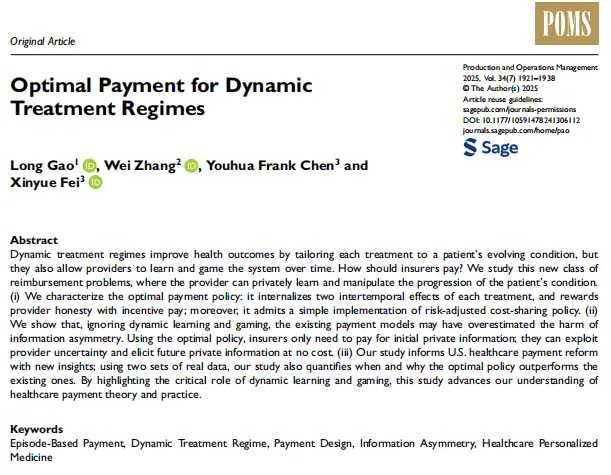
In response to this real-world problem concerning peoples lives, health, and social well-being, ZHANG Wei, a researcher under the "Hundred Talents Program" at the Department of Service Science and Operations Management, School of Management, Zhejiang University, and the collaborators conducted in-depth research. Their findings, "Optimal Payment for Dynamic Treatment Regimes," were recently published in the top international journal Production and Operations Management (one of the UTD24 journals).
|
You can access the Article here |
|
ZHANG Wei | 张伟 School of Management, Zhejiang University |
||
|
|
||
|
|
|
Academic Background: Researcher under the "Hundred Talents Program" in the Department of Service Science and Operations Management, ZJUSOM. Research: mechanism design, information design, supply chain management, healthcare management, and revenue management. You can learn more about ZJU 100-Young Prof. ZHANG Wei’s academic background here |
|
GAO Long | 皋龙 School of Business, University of California, Riverside |
||
|
|
||
|
|
|
Academic Background: Professor of Operations and Supply Chain Management, UCR. Research: supply chain management, stochastic modeling of manufacturing and service systems, Markov decision processes, and simulation. You can learn more about Prof. GAO Long’s academic background here |
|
CHEN Youhua Frank | 陈友华 College of Business, City University of Hong Kong, Hong Kong |
||
|
|
||
|
|
|
Academic Background: Chair Professor of Management Science, CityUHK. Research: projects span healthcare and service systems, logistics and supply chains, and machine learning applications in operations (e.g., applications of LLMs in operations, driving risk assessment, and behavior-based insurance). You can learn more about Prof. CHEN Youhua’s academic background here |
|
FEI Xinyue | 费馨玥 School of Business, Sun Yat-sen University |
||
|
|
||
|
|
|
Academic Background: Assistant Professor in the School of Business, SYSU. Research: healthcare policy design (e.g., medical insurance payment methods), effective improvement of medical service system efficiency, and reduction of medical resource waste. You can learn more about Assistant Prof. FEI Xinyue’s academic background here |
|
Designing an Optimal Healthcare Payment Policy: Theory and Policy Implications |
To explore the optimal payment mechanism, team constructed a "principal-agent model with endogeneous information asymmetry" in their research. In this model, the insurance company acts as the "principal," responsible for designing the payment mechanism for dynamic treatment plans; the medical service institution acts as the "agent," possessing first-hand information about the patients condition, thus holding an informational advantage.
The treatment process is divided into multiple stages in the model. After each stage, the medical service provider reports the patients condition progress to the insurance company, which then makes corresponding payments based on this information.
Based on this model, research team proposed an "optimal medical insurance payment policy" and clarified its main characteristics:
01 | Incentivizing truthful disclosure effectively mitigates opportunistic behavior arising from informational loopholes.
To effectively curb medical service providers from exploiting information asymmetry, insurance companies need to do two things: first, allow medical service providers to adjust treatment plans according to the patients actual condition; second, establish "incentive-based compensation" to reward medical service providers who truthfully report information.
The combination of these two measures can prevent medical service institutions from "picking up" patients and only accepting those with mild symptoms, and can also prevent them from over-treating minor illnesses.
02 | Linking long-term interests via delayed compensation facilitates the acquisition of updated patient information.
For dynamic treatment plans, insurance companies can adopt a "deferred payment" mechanism, essentially retaining a portion of the payment as a "performance deposit," which is then released only after specific treatment outcomes are achieved. This tightly "binds" the interests of healthcare providers with the future recovery results of patients, thereby incentivizing healthcare providers to focus on improving long-term treatment effectiveness.
At the same time, insurance companies can also use this to gradually obtain new information about the patients condition.
03 | Enhancing patient treatment outcomes through the design of behavioral incentive mechanisms.
Insurance companies need to incentivize healthcare providers to incorporate "treatment continuation effects" and "potential effects" into their decision-making, while encouraging them to proactively and flexibly adjust treatment plans based on changes in the patients condition, thereby maximizing the patients treatment outcome.
In addition to the features mentioned above, the optimal medical insurance payment policy also has the characteristic of being "easy to implement," which insurance companies can implement through the cost-sharing method of "risk adjustment."
For example, the cost-sharing ratio between medical insurance and individuals can be dynamically adjusted based on the severity of the patients condition and the level of risk, making the payment plan fairer and more reasonable.

|
Image source: ©千库网 |
|
Advantages of the Optimal Medical Insurance Payment Policy |
In the research, team answered a "key question": When and why is their "optimal medical insurance payment policy" superior to traditional policies?
They found that in dynamic treatment scenarios, past payment models may have overestimated the harm caused by "information asymmetry," assuming that this harm would persist indefinitely. Insurance companies could therefore be misled, continuously overpaying for "information asymmetry" in their payment policies, distorting treatment decisions and impacting patient outcomes.
However, in reality, as long as the payment mechanism is well-designed, the harm caused by this "information asymmetry" is only temporary. Because dynamic treatment involves multiple stages, through repeated interactions, healthcare providers will gradually learn about the patients latest information, and insurance companies can obtain this new information in stages.
This is the advantage of the "optimal health insurance payment policy" - insurance companies only need to pay a one-time reasonable cost for "private information held by medical service institutions in the early stages of treatment," and can obtain "new information" generated during subsequent treatment "for free" through clever payment design.

|
Image source: ©千库网 |
Based on two sets of real data, team also quantitatively analyzed when and why the optimal policy is superior to the traditional policy. The results showed that the optimal policy incorporates both the continuation and potential effects of the treatment plan into the decision-making process, clarifies all payment terms in advance, and limits the information advantage of healthcare institutions to the initial stage. This can correct the shortcomings of the traditional policy in terms of "decision-making" and "information," and has a significant improvement effect in various scenarios.
In particular, when healthcare providers are less concerned about their reputation, and the potential and lasting effects of treatment are strong, the optimal policy is significantly better than the traditional policy.
|
Dynamic Treatment Incentives and Medical Insurance Payment Reform |
As a core pillar of personalized medicine, dynamic treatment plans are now widely used in the treatment of chronic diseases such as cancer, AIDS, and hypertension. However, this treatment approach has given healthcare providers the opportunity to exploit informational advantages, leading to the increasingly common phenomenon of "over-treatment" in recent years.
To reduce these phenomena, insurance companies must design health insurance payment policies from a dynamic perspective. However, current research in this area in the medical field is relatively scarce, and existing payment models oversimplify the behavior of healthcare service providers, neglecting the possibility that healthcare service providers may exploit informational advantages to "take advantage" of loopholes in dynamic treatment plans.
The study not only fills this research gap, emphasizing the impact of healthcare service institutions "information learning" and "loophole exploitation" on medical insurance payments and patient treatment outcomes, deepening the academic communities understanding of medical insurance payment theory and practice, but also provides new insights for medical insurance payment reform.
01 | The setting of incentive-based compensation and treatment restrictions should be calibrated based on the sustained and potential effects of specific treatments, and these measures should only be used in the initial stage of treatment and should eventually be phased out.
02 | Simplified payment policies (such as charge-per-service or bundled payments) are not optimal for dynamic treatment scenarios. To achieve the dual goals of cost control and quality improvement, payment policies must include reward and penalty clauses with continuous objectives.

|
Image source: ©千库网 |
|
- We thank Prof. ZHANG Wei and the research team for their valuable contribution to advancing the understanding of optimal medical insurance payment design under dynamic treatment regimes, and for elucidating how incentive-compatible mechanisms can mitigate information asymmetry, curb excessive medical practices, and improve patient treatment outcomes in the era of personalized medicine.
- You can read the original article in Chinese here