Data shows that as of June 2019, among the more than 4,000 companies listed on the NYSE and Nasdaq in the United States, only 262 had ever invested in blockchain technology. Among the MSCI World Index constituents, only 100 companies announced the launch of blockchain projects between 2015 and 2019. The situation in China is similarly concerning. Of the 7,598 Chinese companies listed on the Shanghai and Shenzhen stock exchanges between 2018 and 2021 , only 3.07% actually adopted blockchain technology in their supply chain management. This means that during this period, only 3 out of every 100 companies truly took the first step in blockchain application.

|
Image source: ©千库网 |
Since its inception with Bitcoin in 2008, blockchain technology has been touted as a game-changer for supply chains. However, the reality is that large-scale implementations of blockchain in supply chains globally remain scarce. Why is such a potentially groundbreaking technology struggling to gain traction? WANG Wenming, a researcher under the "Hundred Talents Program" at the School of Management, Zhejiang University, and collaborators have focused on the crucial role of "major customers" for the first time, finding that the higher a suppliers dependence on major customers (higher customer concentration), the less likely they are to adopt blockchain technology. This research, published in Production and Operations Management (one of the UTD24 journals), a top journal in operations management, systematically reveals the inhibitory effect of major customer concentration on supplier blockchain adoption and its underlying mechanisms.
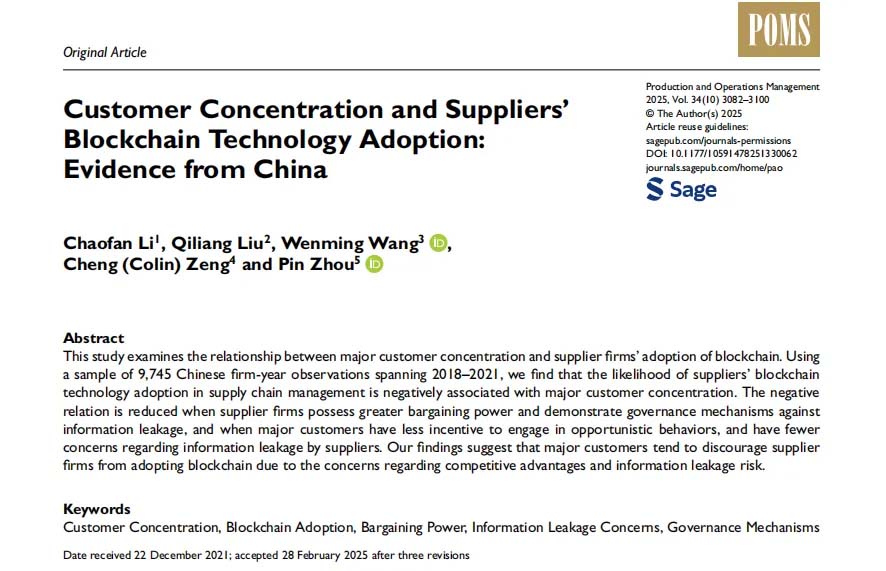
|
You can access the Article here |
|
WANG Wenming | 王文明 School of Management, Zhejiang University |
||
|
|
||
|
|
|
Academic Background: Hundred Talents Researcher, ZJUSOM. Research: financial accounting, supply-chain ties, governance, CSR, debt financing. You can learn more about ZJU 100-Young Professor WANG Wenming’s academic background here |
|
LI Chaofan | 李超凡 School of Management, Wuhan University of Technology |
||
|
|
||
|
|
|
Academic Background: Associate Researcher at WUT. Research: supply chain management and auditing, with her research also covering broader areas like supplier location impacts on supply chain recovery. You can learn more about Associate Researcher LI Chaofan’s academic background here |
|
LIU Qiliang | 刘启亮 School of Accountancy, Jiangxi University of Finance and Economics |
||
|
|
||
|
|
|
Academic Background: Professor in the School of Accountancy at JXUFE. Research: accounting, auditing, and finance, often focusing on topics like corporate governance, market behavior, and crisis impacts on auditors. You can learn more about Prof. LIU Qiliang’s academic background here |
|
ZENG Cheng (Colin) | 曾诚 School of Accounting and Finance, Hong Kong Polytechnic University |
||
|
|
||
|
|
|
Academic Background: Associate Professor of Accounting at PolyU. Research: encompassing accounting, finance, and economics. Specific areas of focus include the influence of political and regulatory factors on financial reporting, International Financial Reporting Standards (IFRS), and China-related topics. You can learn more about Associate Prof. ZENG Cheng (Colin)’s academic background here |
|
ZHOU Pin | 周品 School of Economics and Management, Huazhong Agricultural University |
||
|
|
||
|
|
|
Academic Background: Associate Professor, HZAU. Research: supply chain management, game theory, corporate social responsibility (CSR), carbon emission policies, and product line optimization. You can learn more about Associate Prof. ZHOU Pin’s academic background here |
|
Customer Dependence and Blockchain Adoption |
Theoretically, blockchain technology, through a decentralized distributed ledger, can achieve end-to-end transparency, information sharing, and automated execution of smart contracts throughout the supply chain. From traceability and anti-counterfeiting to inventory optimization, from reducing disputes to improving efficiency, the potential value of blockchain is obvious. But why are suppliers so cautious about this seemingly promising technology?

|
Image source: ©千库网 |
Research has found that the higher a companys sales share from its top five customers, or the stronger its reliance on a single customer, the less likely the supplier is to introduce blockchain technology in the following year. In other words, a suppliers dependence on major customers directly impacts its pace of technological innovation.
The reason why major clients "reject" blockchain technology is due to complex and realistic considerations.
■ Concerns Regarding Information Leakage
Despite blockchains reputation for cryptographic security, major clients are concerned that their trade secrets, transaction data, and other sensitive information could be leaked on blockchain platforms. One executive involved in the survey frankly stated, "Some of our production processes are core competitive advantages; if competitors were to acquire them through a blockchain platform, the consequences would be unimaginable."
■ Concerns over the Loss of Bargaining Power
For a long time, large customers have leveraged their purchasing scale to negotiate more favorable terms and secure more advantageous deals with suppliers - a form of "bargaining power." However, the transparency of blockchain technology may weaken this advantage derived from information asymmetry. Blockchain technology helps suppliers overcome geographical limitations, reach more diverse customers, and reduce their reliance on existing large customers, directly impacting the interests of these large customers.
■ Concerns over Technological Risk
From the perspective of major clients, blockchain is still an emerging technology, and its security and stability still need time to be verified. They worry that if problems arise during the application of the technology by suppliers, it could affect their own production and operations, causing unnecessary losses.
|
Finding Balance in Strategic Interactions: Key Leverage Points Identified by the Study |
When it comes to the adoption of blockchain technology, is it solely up to large clients to decide? The research team conducted an in-depth analysis of various scenarios and found that not all suppliers are "restricted" by large clients. Paying attention to these points can help break the deadlock in the process of technology advancement.
First and foremost, enhancing ones own capabilities is the key. When suppliers possess strong bargaining power, the negative impact of customer concentration is significantly reduced. Companies with unique and irreplaceable advantages in the product market are better positioned to independently determine their technological path, including whether to adopt supply chain technologies. This suggests that continuously improving product competitiveness and brand value is fundamental to maintaining control in supply chain relationships.
|
Image source: ©千库网 |
Secondly, establishing trust mechanisms is crucial. Research shows that when companies have independent directors with IT expertise on their boards or establish professional risk management committees, major clients concerns are significantly reduced. These governance mechanisms send an important signal to clients: "We value and are capable of ensuring information security." In a real-world example, a manufacturing company successfully alleviated the concerns of its major clients and smoothly advanced its blockchain project by introducing information security experts into its board. For suppliers, establishing a professional information security governance team not only promotes the implementation of blockchain technology but also enhances customer trust.
Furthermore, communication and understanding are equally crucial. Companies with strong innovation capabilities and a focus on long-term partnerships show significantly higher acceptance of blockchain. If customers can be convinced that blockchain technology will ultimately lead to win-win outcomes, they are more likely to adopt it. Consensus can be built through methods such as pilot projects demonstrating practical effects and inviting customers to participate in solution design.

|
Image source: ©千库网 |
Its worth noting that the choice of blockchain type is also important. Large clients tend to resist private blockchains more strongly, as this often implies complete control of the system by the provider. Public or consortium blockchains, on the other hand, are more readily accepted due to their greater transparency.
|
Managerial Implications: How Firms Can Retain Strategic Control in Technology Adoption |
While large clients may be conservative in their adoption of blockchain, research confirms that blockchain can indeed bring substantial economic benefits to suppliers. Data shows that blockchain adoption significantly mitigates the negative impact of customer concentration on corporate profitability. This means that blockchain technology, as expected, helps companies improve their market position and profitability by increasing supply chain transparency and reducing information asymmetry. Based on this finding, the research also provides three key insights for enterprise management practices in digital transformation:
01 | Reassessing Customer Structure to Reduce Single-Customer Dependence
Businesses need to realize that over-reliance on a few large clients may inadvertently hinder their technological innovation and digital transformation. They should actively promote customer diversification and balance short-term revenue with long-term technological capability development.
02 | Investing in Governance Mechanisms to Build Customer Trust
For businesses, establishing risk committees, bringing in responsible personnel with relevant backgrounds, and strengthening data security systems are all measures that, while not necessarily bringing direct benefits, can send a signal to customers that "information security is guaranteed," thereby reducing their resistance.
03 | Emphasizing Communication and Value Co-Creation
Given the critical importance of communication and understanding in the process of technological advancement, suppliers should proactively demonstrate the security mechanisms and win-win value of blockchain systems to major clients. Specifically, this can be achieved by piloting solutions in non-core business areas to demonstrate value through tangible results; by targeting clients with a higher acceptance of technological innovation; and by prioritizing more readily accepted solutions such as consortium blockchains to gain the understanding and support of key clients.

|
Image source: ©千库网 |
In this era of rapid technological change, businesses face not only the challenge of choosing the right technologies, but also the wisdom to find a balance between the old and new paradigms. Understanding and balancing the interests of all parties is essential for sustainable and successful digital transformation.
This research offers insights into the bottlenecks in promoting blockchain technology: suppliers should strengthen their internal capabilities, enhance their bargaining power, and ensure information security through institutional safeguards; major customers should acknowledge the technological trend, integrate their concerns into solution design, and actively participate in technology co-construction and trust collaboration; and at the policy level, it is crucial to build robust platforms and a strong security network. Only when these three parties work together can blockchain truly play its role, making the supply chain more transparent, efficient, and trustworthy.
|
- We thank ZJU 100-Young Prof. WANG Wenming and the research team for their valuable contribution to advancing the understanding of how major customer dependence affects suppliers’ adoption of blockchain technology and the mechanisms through which companies can navigate digital transformation in supply chain management.
- You can read the original article in Chinese here