Startups often face numerous severe challenges: resource scarcity, manpower shortages, high uncertainty, etc. These challenges can hinder the company’s development and even threaten its survival. Among these, recruiting and retaining suitable talent and building a strong workforce are key points and difficulties for startups to succeed.
The difficulties of recruiting and retaining talent are particularly pronounced in male-led startups. Research indicates that these companies often suffer from a shortage of female talent, which not only limits access to diverse perspectives and innovative ideas but also hinders the formation of an inclusive work culture, making them more prone to bottlenecks in talent recruitment and team building. So, how can startups overcome these challenges?

|
Image source: ©千库网 |
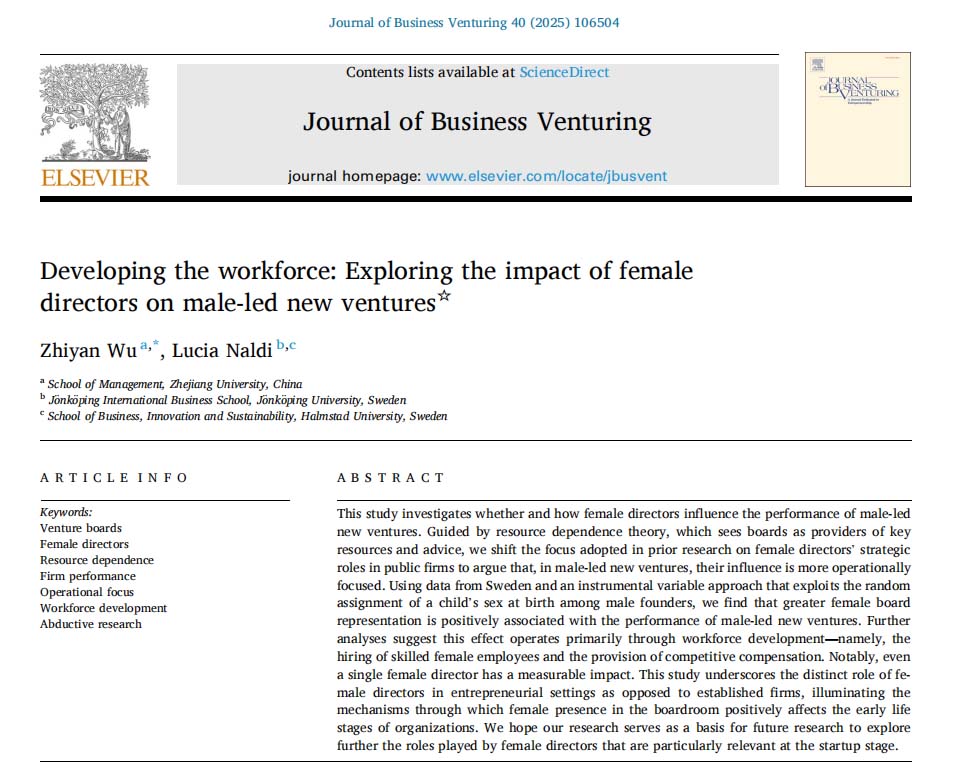
A study published in the top entrepreneurship journal Journal of Business Venturing (FT50 journal), a collaboration between Professor WU Zhiyan of the Department of Innovation, Entrepreneurship and Strategy at the School of Management, Zhejiang University, and Professor Lucia Naldi of Jönköping International Business School in Sweden, focuses on the gender composition of startup boards. They argue that boards play a crucial role in providing key resources and operational guidance, and that in male-founded startups, adding female directors significantly improves performance; in fact, even a single female director can generate substantial revenue growth.
|
You can access the Article here |
Research has found that female directors have unique value in the entrepreneurial environment. They do not rely on the traditional “expansion model” but inject growth momentum into the company by empowering “employee development” at the operational level. Her addition is not a symbolic “diversity label” but brings real operational optimization and talent strategy upgrades.
|
WU Zhiyan | 吴志岩 School of Management, Zhejiang University |
||
|
|
||
|
|
|
Academic Background: Professor and doctoral supervisor at ZJUSOM. His research focuses on corporate strategic management, and he is skilled in using causal inference methods. You can learn more about Prof. Wu Zhiyan’s academic background here |
|
Lucia Naldi International Business School, Jönköping University |
||
|
|
||
|
|
|
Academic Background: Professor in Business Administration and Vice President for Research. Her main research and teaching are in the areas of entrepreneurship, international business and strategy. You can learn more about Prof. Lucia Naldi’s academic background here |
|
What substantial changes have female directors brought about? An insight based on a “natural experiment” |
Previous research on gender diversity on boards of directors has largely focused on listed companies, emphasizing the role of female directors in strategic mergers and acquisitions, capital operations, and other areas. However, these “high-level” strategies are often not applicable to startups; they require more “down-to-earth” operational support - especially in attracting and retaining talent. Against this backdrop, this study raises a question worthy of in-depth exploration: In male-dominated startups, can female directors truly play a role? If so, how? The answer to this question is not only about gender diversity but also about the governance effectiveness and long-term development potential of startups.
However, a key challenge in studying the impact of female directors on companies lies in the fact that high-performing companies may inherently prefer appointing female directors, rather than female directors causing performance improvement. This presents a challenge in identifying causal relationships. How to address this? This study cleverly utilizes a natural phenomenon – the random distribution of the founder’s children’s gender – as an instrumental variable when selecting its experimental sample. Previous research has found that male founders with daughters are more likely to appoint female members to their boards. Since the gender of children is “exogenous”, unaffected by the founder’s personal preferences or company characteristics, this provides an ideal research window: with the same number of children, it allows for comparison of performance differences between companies that appoint female directors solely because they have daughters (rather than due to company characteristics) and those that do not. This design effectively identifies the causal effect of female directors on corporate performance, thus ensuring the scientific validity and robustness of the research conclusions.
The higher the proportion of female directors, the better the company’s performance.
Based on a sample of 50,055 male-owned startups in Sweden from 2004 to 2017, the study shows that a higher proportion of female directors correlates with more significant sales growth. Specifically, adding a female director to a typical two-person board can increase company revenue by an average of approximately 45% annually. This result remains stable across different samples and analytical methods – the positive impact of female directors is evident in micro-enterprises with fewer than 10 employees, young companies less than 3 years old, and non-family businesses. This indicates that the positive impact of female directors on startup performance is not accidental but rather a widespread phenomenon.

|
Image source: ©千库网 |
Growth doesn’t rely on “expansion,” it relies on “employee development.”
Did female directors achieve performance growth by “opening more stores and scaling up”? Data analysis shows a negative answer; approximately 80% of revenue growth is attributed to the following two key mechanisms:
01 | Recruit more high-caliber female talents
Female directors are more inclined to promote inclusive hiring, especially attracting female employees with bachelor’s degrees or higher. This not only enriches the company’s talent pool and diversity but also introduces more diverse perspectives and skills, enhancing the company’s innovation and adaptability.
02 | Offer more competitive compensation and benefits
Female board members tend to prioritize fairness and growth within the team, focus on long-term talent development, excel at building an inclusive organizational culture, and are more inclined to emphasize incentive and retention mechanisms in compensation design. These qualities are precisely the key elements needed by startups during their rapid growth phase. Research shows that their advocacy for increased salaries and allowances on the board enhances employee satisfaction, stability, and a sense of belonging, ultimately translating into stronger performance.
This is an “inside-out” growth logic: build the team first, then discuss expansion; stabilize morale first, then plan for the market. In the early stages of development when resources are highly limited, human capital is often the most core asset of a company. The ability to establish effective mechanisms for attracting, cultivating, and retaining talent is directly related to the survival and development of the company. Female directors, through their leadership style that emphasizes relationship building, teamwork, and employee development, help companies build a more solid organizational foundation and provide continuous momentum for future development.
Even with just one woman, the situation can be “changed”.
Traditional views hold that “a certain number of women are necessary on the board of directors to realize the benefits of diversity.” For example, in publicly traded companies, a single female director may be too isolated to influence final decisions. However, this study challenges this assumption. In male-led startups, even a single female director on the board can significantly improve company performance.

|
Image source: ©千库网 |
Why can a single female director play such a significant role in a startup without requiring a “numerical advantage”? This is closely related to the characteristics of startups: First, startup boards are smaller, decision-making processes are more streamlined, and each member has greater say and actual influence. In such an environment, even the voice of a single woman is more likely to be heard, valued, and translated into concrete action. Second, startups have limited resources and are unlikely to make “figurehead” appointments; in such companies, female directors are often selected based on their professional competence, enabling them to truly participate in core decision-making and drive the implementation of “employee development” initiatives.
|
This research rewrites “traditional understanding” and provides insights for entrepreneurs, investors, and policymakers |
Previous research has largely overlooked the “gender dimension” of startup boards of directors, even implicitly assuming that “female directors are unsuitable for startups.” This study breaks through this blind spot, distinguishing the different roles of female directors in “startups” and “mature companies” (publicly listed companies) - mature companies emphasize “strategic expansion”, while startups emphasize “employee development”. This distinction highlights the importance of context. In startups, even a single female director can exert substantial influence, breaking the traditional perception that “a numerical advantage of female directors is necessary for effectiveness.”

|
Image source: ©千库网 |
In terms of practical value, different stakeholders can gain insights from this:
■ For male entrepreneurs, inviting women to their boards should not be seen as a symbolic move towards gender diversity, but rather a strategic choice that can genuinely boost revenue. Female directors help companies quickly build a human capital advantage and achieve quantifiable growth by optimizing talent recruitment and organizational structure.
■ For investors, the presence of female members on the early board of directors can be an important indicator of a company’s potential. This often signifies that the company is building the human resources infrastructure to support scalable growth, making it more likely to achieve sustained growth.
■ For policymakers, promoting gender equality does not necessarily require high-cost intervention. By building platforms to effectively match male business founders with qualified female board candidates, a synergistic effect can be achieved between promoting gender diversity and fostering entrepreneurial growth, resulting in cost-effective policy outcomes.

|
Image source: ©千库网 |
Research scientifically identifies the value of female directors in startups – they are not merely “symbols” of “diversity”, but rather “growth engines” that drive business development. Female directors bring not only a complementary gender perspective but also a management philosophy that places greater emphasis on talent development and organizational building. This philosophy aligns perfectly with the agility, adaptability, and sustainability required by modern startups, becoming a crucial force driving their steady growth.
In a rapidly changing business environment, companies that can integrate different perspectives and absorb diverse wisdom are often more innovative and resilient and are more likely to find a breakthrough path in uncertainty and achieve sustained and healthy growth.
|
- We thank Prof. Wu Zhiyan and Lucia Naldi for their valuable contribution to advancing the understanding of how female directors enhance startup performance through talent development and inclusive organizational practices.
- You can read the original article in Chinese here