In business, supplier–customer relationships are a crucial but fragile link. Information asymmetry often stands like a wall between the two sides, making suppliers hesitant to invest in customer-specific innovation. When a supplier considers developing a new component for a key customer, beyond technical difficulty the real worry is whether the customer’s fundamentals are sound: will orders be cut suddenly, or will the buyer run into financial trouble?

|
Image source: ©千库网 |
These frictions restrain collaborative innovation along supply chains. Suppliers must commit resources that are often specific to a particular customer relationship. If the customer faces distress or pursues aggressive risk-taking, suppliers become exposed and the return to innovation is threatened. Here, the bond market acts as a sensitive observer: bond prices encode signals about a firm’s financial health and risk, and transmit those signals to outside stakeholders.
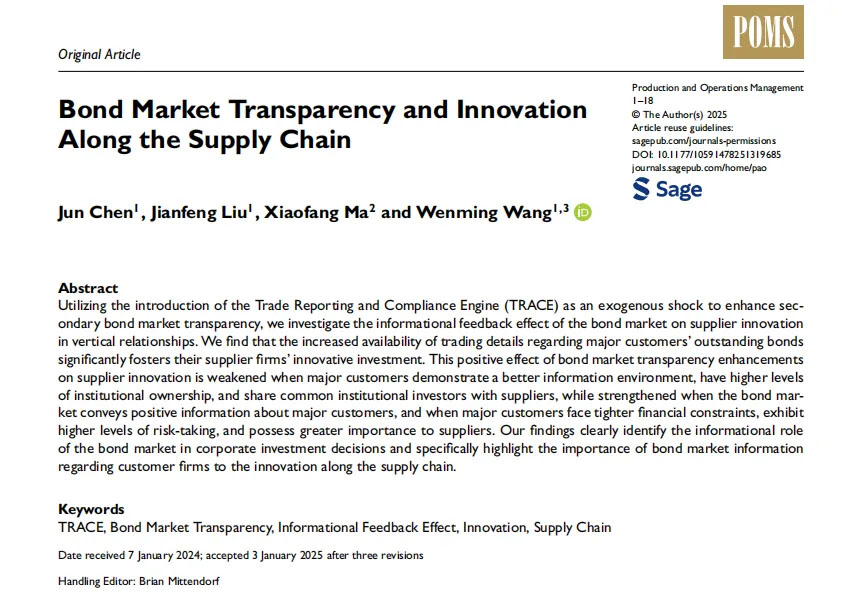
Transparency in the bond market opens a window for suppliers to learn more about customers through trading information. But how exactly does transparency shape suppliers’ innovation decisions? A new study by Zhejiang University’s School of Management (ZJUSOM), published in Production and Operations Management, finds that when customers’ bond trading becomes more transparent, their suppliers increase innovation investment.
|
You can access the Article here |
|
CHEN Jun | 陈俊 School of Management, Zhejiang University |
||
|
|
||
|
|
|
Academic Background: Professor, Doctoral Supervisor, ZJUSOM. Research: auditing & internal control, disclosure, capital markets, financial intelligence. You can learn more about Prof. CHEN Jun’s academic background here |
|
WANG Wenming | 王文明 School of Management, Zhejiang University |
||
|
|
||
|
|
|
Academic Background: Hundred Talents Researcher, ZJUSOM. Research: financial accounting, supply-chain ties, governance, CSR, debt financing. |
|
LIU Jianfeng | 刘剑峰 School of Management, Zhejiang University |
||
|
|
||
|
|
|
Academic Background: PhD candidate (2021 cohort), ZJUSOM. Research: financial accounting, supplier–customer relationships, corporate innovation. |
|
01. The overlooked signals in bond markets |
Equities are often treated as the primary arena for firm information. Yet the corporate bond market is comparable in size and dominated by institutional investors who are especially attentive to downside risk. Because bondholders’ payoff is asymmetric, they tend to react faster and more strongly to bad news. Bond prices can flag deteriorations in fundamentals earlier than stock prices — making the bond market an independent source of information.

|
Image source: ©千库网 |
Before 2002, U.S. OTC corporate-bond trade details were not public. FINRA’s phased rollout of the TRACE system in July 2002 mandated post-trade disclosure (price, size, time) for almost all eligible corporate bonds, creating a natural experiment. Which bonds became transparent depended on issuance size and credit rating, not on managerial choices.
Using U.S. supplier–customer pairs from 1997–2010, the study compares suppliers’ innovation before and after TRACE.
|
02. How transparency moves the innovation lever |
Across 14,806 supplier–customer pairs, increased bond-market transparency led to higher supplier innovation: patent counts rose by 7.1%, quality (citations) improved by 14%, and R&D spending increased. Crucially, innovation tilted toward technologies related to the focal customer’s domain, indicating bolder, relationship-specific investment.

|
Image source: ©千库网 |
Heterogeneity tests show:
■ Asymmetric information content: When bond signals conveyed good news, suppliers’ innovation rose; when signals conveyed bad news, there was no further cut — consistent with defensive under-investment under prior uncertainty.
■ Substitution by other information channels: If a customer’s own disclosure environment was already strong, or if suppliers and customers shared institutional investors, the added value of bond transparency diminished.
■ Amplification by customer finance/risk: Effects were stronger when customers faced tighter financing constraints or took more risk — transparency eased financing and boosted suppliers’ confidence in long-term cooperation.

|
Image source: ©千库网 |
|
03. Three mechanisms that ease supply-chain frictions |
01. Clearing the fog of information
TRACE turns bond prices into verifiable, timely signals suppliers can cross-check against customer promises, with earlier warnings when performance disappoints.

|
Image source: ©千库网 |
02. Lower customer financing costs
Prior evidence shows TRACE narrowed bond spreads and improved loan/equity financing conditions. That reduces bankruptcy risk and raises demand prospects — a double assurance for suppliers.
03. Tighter market discipline
Visible trading lets investors detect risky behavior sooner, nudging managers toward more prudent policies and reassuring suppliers.

|
Image source: ©千库网 |
|
04. Implications for management and policy |
01 | The role of financial markets as an information laboratory beyond equities;
02 | Supply-chain governance, where third-party market signals lower monitoring costs when direct sharing is selective;
03 | And policy evaluation, showing TRACE’s investor-protection goal also created positive spillovers that reduce supply-chain frictions and stimulate upstream innovation (a useful frame for jurisdictions promoting post-trade disclosure (including China’s interbank market)).
|
- We thank Prof. CHEN Jun and his research team for their valuable contribution to advancing the understanding of how financial-market transparency supports innovation along the supply chain.
- You can read the original article in Chinese here