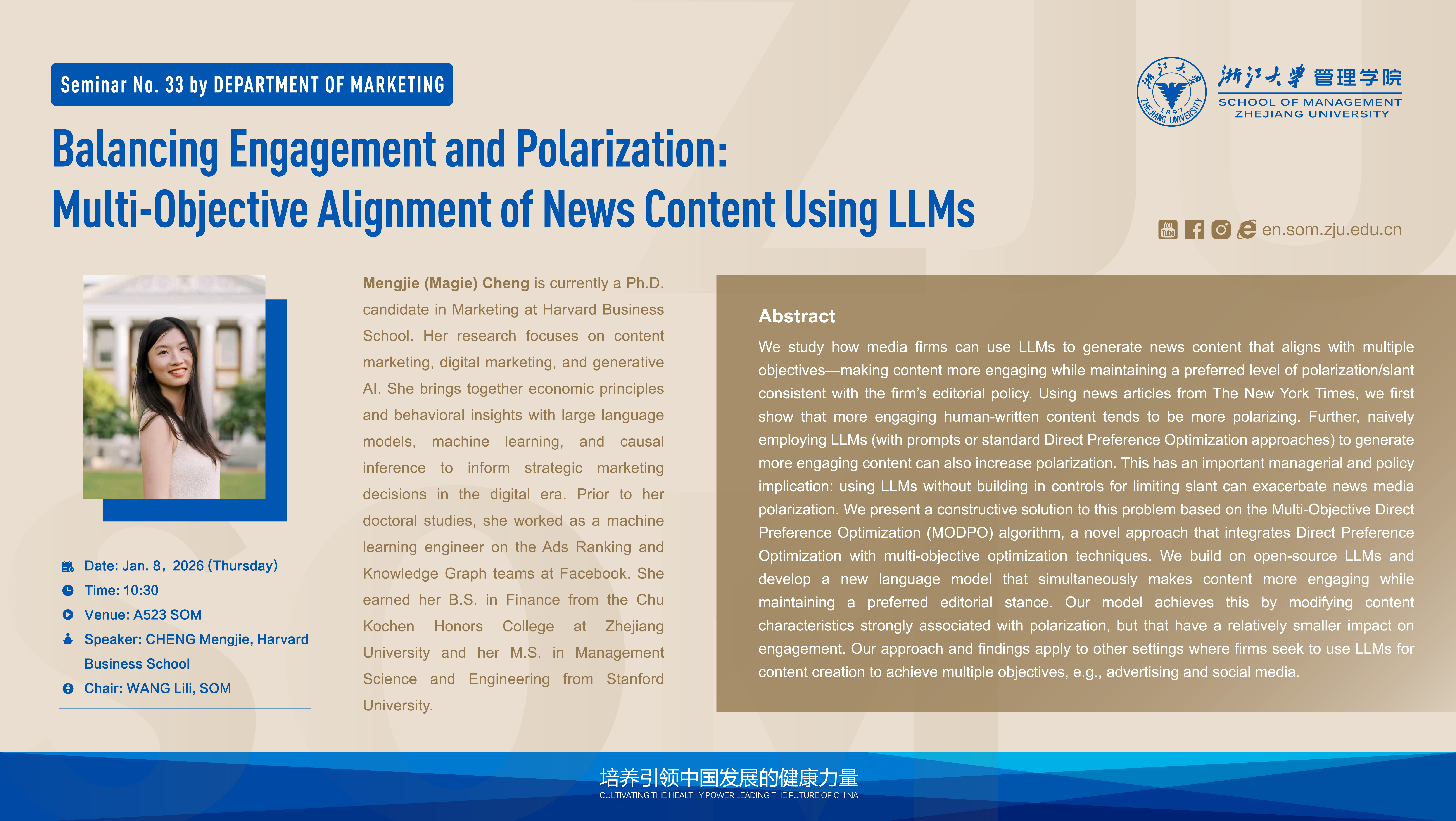
Seminars topic: This talk examines how media organizations can use large language models (LLMs) to generate news content that balances multiple objectives-enhancing user engagement while maintaining a desired level of polarization or editorial slant. Using news articles from The New York Times, the study shows that more engaging human-written content tends to be more polarizing, and that naïvely using LLMs to boost engagement can further intensify polarization. To address this challenge, the speaker introduces a constructive solution based on the Multi-Objective Direct Preference Optimization (MODPO) algorithm, which integrates direct preference optimization with multi-objective techniques. The proposed approach enables LLMs to generate content that is more engaging while preserving a preferred editorial stance by selectively modifying content attributes strongly associated with polarization but less critical for engagement. The findings offer important managerial and policy implications and extend to other domains such as advertising and social media content creation.
Scholars Background: Mengjie (Magie) CHENG is a Ph.D. candidate in Marketing at Harvard Business School. Her research focuses on content marketing, digital marketing, and generative AI, combining economic theory and behavioral insights with large language models, machine learning, and causal inference to inform strategic marketing decisions. Prior to her doctoral studies, she worked as a machine learning engineer on the Ads Ranking and Knowledge Graph teams at Facebook. She holds a B.S. in Finance from Chu Kochen Honors College at Zhejiang University and an M.S. in Management Science and Engineering from Stanford University.
Time and Location: January 8, 2026, 10:30, Room A523, School of Management
Language: EN
Host: Prof. WANG Lili, School of Management, Zhejiang University