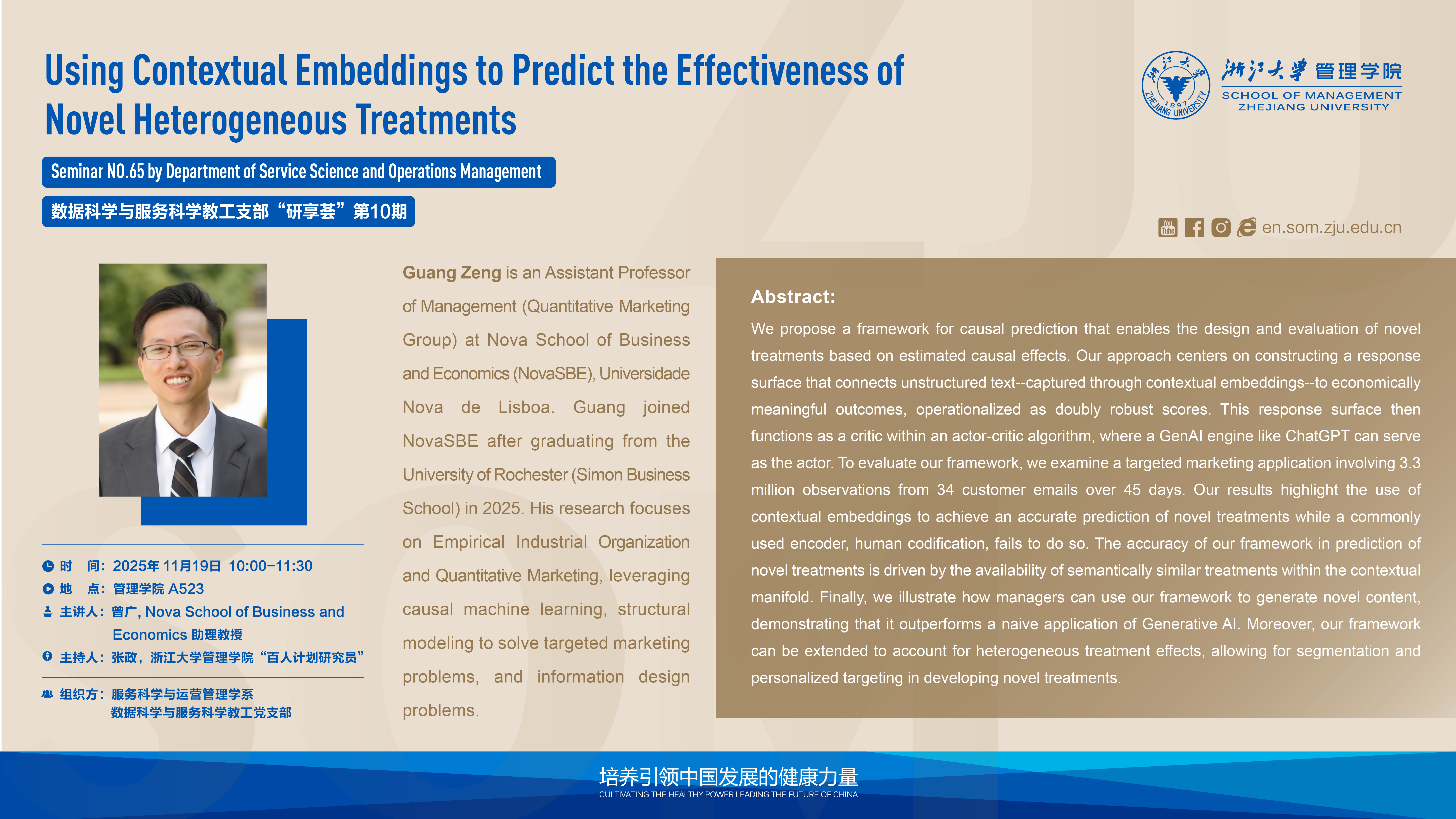
Seminars topic: The study introduces a causal prediction framework designed to support the development and evaluation of novel treatments by leveraging estimated causal effects. The core of the approach is a response surface that links unstructured text—captured through contextual embeddings—to economically meaningful outcomes, represented as doubly robust scores. This response surface then serves as a critic within an actor-critic algorithm, in which a GenAI engine such as ChatGPT can act as the actor. Using a targeted marketing application with 3.3 million observations drawn from 34 customer emails over a 45-day period, the researchers show that contextual embeddings enable highly accurate prediction of novel treatments, outperforming models that depend on human codification. The framework can also be extended to account for heterogeneous treatment effects, making it applicable for segmentation and personalized targeting when developing new treatments.
Scholars Background: Guang Zeng is an Assistant Professor of Management (Quantitative Marketing Group) at Nova School of Business and Economics (NovaSBE), Universidade Nova de Lisboa. He joined NovaSBE after graduating from the University of Rochester (Simon Business School) in 2025. His research focuses on Empirical Industrial Organization and Quantitative Marketing, leveraging causal machine learning, structural modeling to solve targeted marketing problems, and information design problems.
Time and Location: November 19, 2025, 10:00–11:30, Room A523, School of Management
Language: EN
Host: Prof. Zhang Ke